

Key takeaways
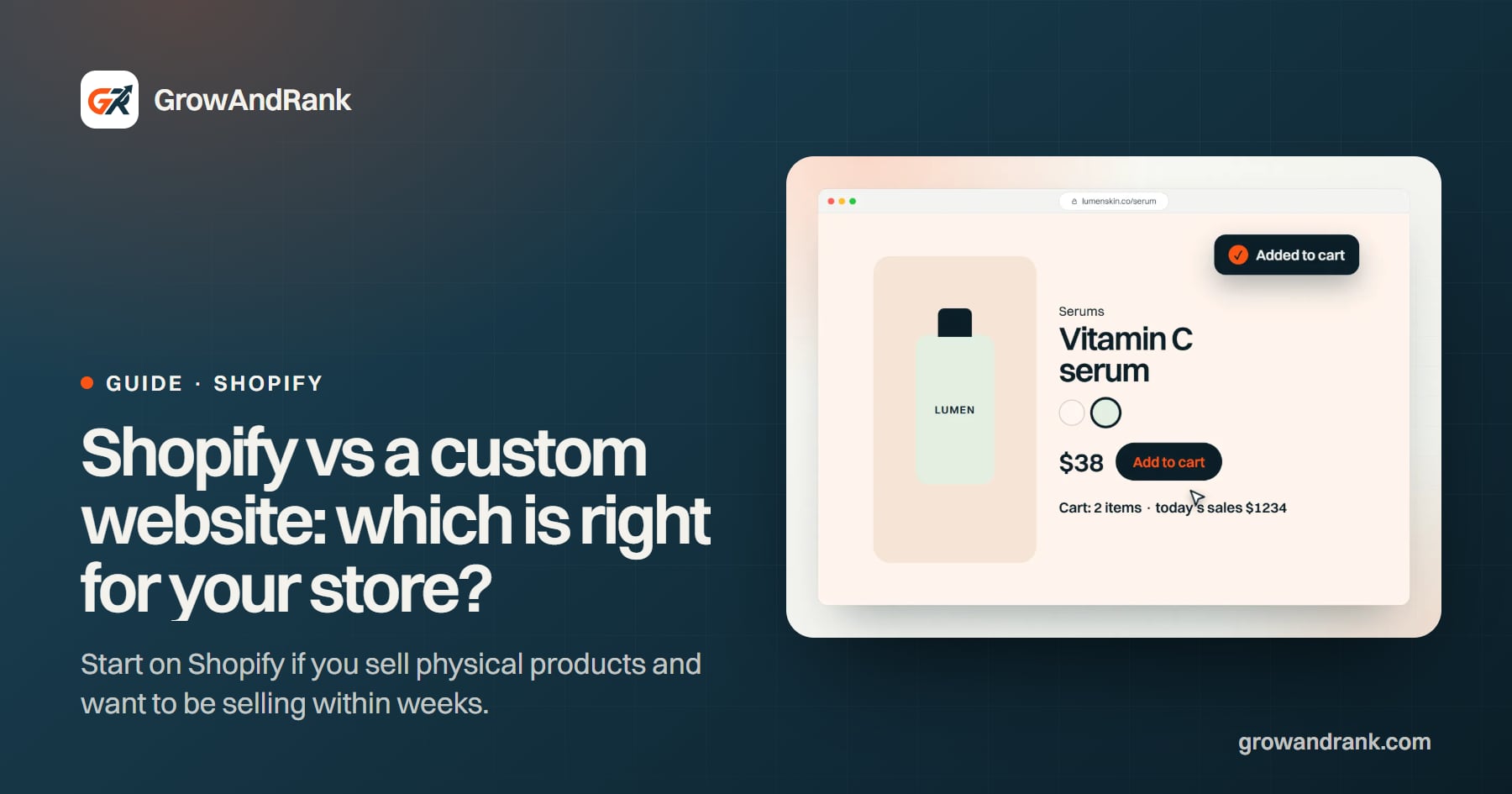
- Start on Shopify if you sell physical products and want to be selling within weeks.
- Go custom or headless only when your storefront experience can’t live inside a theme.
- For most growing brands, a custom-designed Shopify theme is the best of both.
- Budget for apps, changes and content after launch, not only the build.
Shopify vs a custom website: the short answer
If you sell physical products and want to be taking orders within weeks, start on Shopify. Checkout, payments, taxes, shipping rates and order management are solved problems there, and rebuilding them yourself takes months and rarely ends better.
Go custom when the thing that makes your business different cannot live inside a store theme: a product configurator, a subscription model with unusual rules, a marketplace with many sellers, or content and commerce woven together so tightly that a theme gets in the way.
Is Shopify good for a small business?
For most small and growing product brands, yes. Shopify is the sensible default when most of these are true:
- Your catalogue is products with variants, not services or bookings.
- You want to edit products, prices and banners yourself without a developer.
- You rely on apps for reviews, upsells, email or loyalty.
- Your team is small and you would rather not own servers, security patches or payment compliance.
- You need to launch this season, not next year.
Shopify vs Next.js: when a custom storefront earns its cost
A custom build, usually Next.js on the front with Shopify still handling products and orders behind it, pays off when the storefront itself is the product experience. Think of a furniture brand where customers build a sofa piece by piece, a brand whose editorial content drives most sales, or a store that has to load instantly in markets with slow mobile networks.
It also makes sense when you have outgrown apps: five scripts fighting over the product page, each slowing the store down and each with its own monthly fee.
The trade-off is ownership. A custom storefront needs developers to change layouts, someone to watch performance and security, and a budget that continues after launch. If nobody will own it, it will age quickly.
What is headless Shopify, and do you need it?
Headless Shopify means Shopify runs the products, cart and checkout, while a separate front end, often built with Next.js, draws every page the customer sees. You get full design freedom and very fast pages, and you keep Shopify’s reliable checkout.
You need it when the front end is holding sales back: when a theme cannot do what your product pages need, or when speed on mobile is costing you customers you can measure. You do not need it just to look premium; a well-designed custom theme gets you most of the way.
The middle path: a custom Shopify theme
For most growing brands the best answer is neither a stock theme nor a full custom build. It is Shopify with a theme designed and coded around the brand: custom sections, product pages built for how your customers decide, and only the apps you really need.
You keep everything Shopify does well, your team can still edit the store, and it stops looking like every other store on the same theme. When you outgrow it, moving the front end to headless is a contained project, not a rebuild from zero.
Shopify running costs to plan for
The build is only part of the bill. Whichever route you pick, write down what you will pay every month and every year:
- Platform subscription and transaction or payment fees.
- App subscriptions, which add up faster than most owners expect.
- Hosting, monitoring and security for anything custom.
- Developer time for changes after launch: new landing pages, seasonal campaigns, fixes.
- Content: product photos, copy and SEO pages, which matter more than the platform.
Five questions to ask before you decide
Answer these honestly and the choice usually makes itself:
- What will customers do on our store that a normal product page cannot handle?
- Who on our team will edit the store every week, and how technical are they?
- How many apps are we running today, and what do they cost in fees and speed?
- How quickly do we need to launch, and what happens if we miss that date?
- Do we have budget to keep improving the store after launch, or only to build it?
Frequently asked questions
Is Shopify better than a custom website?
For most product brands, yes, at least to start. Shopify gives you a reliable checkout, payments, shipping and an admin your team can use on day one. A custom website is better only when your store needs something a theme cannot do, and you have budget to maintain it.
Can you use Next.js with Shopify?
Yes. This is called headless Shopify: Next.js draws the pages, and Shopify’s Storefront API supplies the products, cart and checkout. It gives full design freedom and fast pages while keeping Shopify’s checkout.
Is headless Shopify worth it for a small store?
Usually not at first. A custom-designed Shopify theme is faster to build and cheaper to run. Headless becomes worth it when you can show that the front end, not the products or marketing, is limiting sales.
Can I move from a Shopify theme to headless later?
Yes. Your products, customers and orders stay in Shopify, so moving to a headless front end later replaces only the pages customers see. Planning clean product data and URLs now makes that move easier.