

Key takeaways
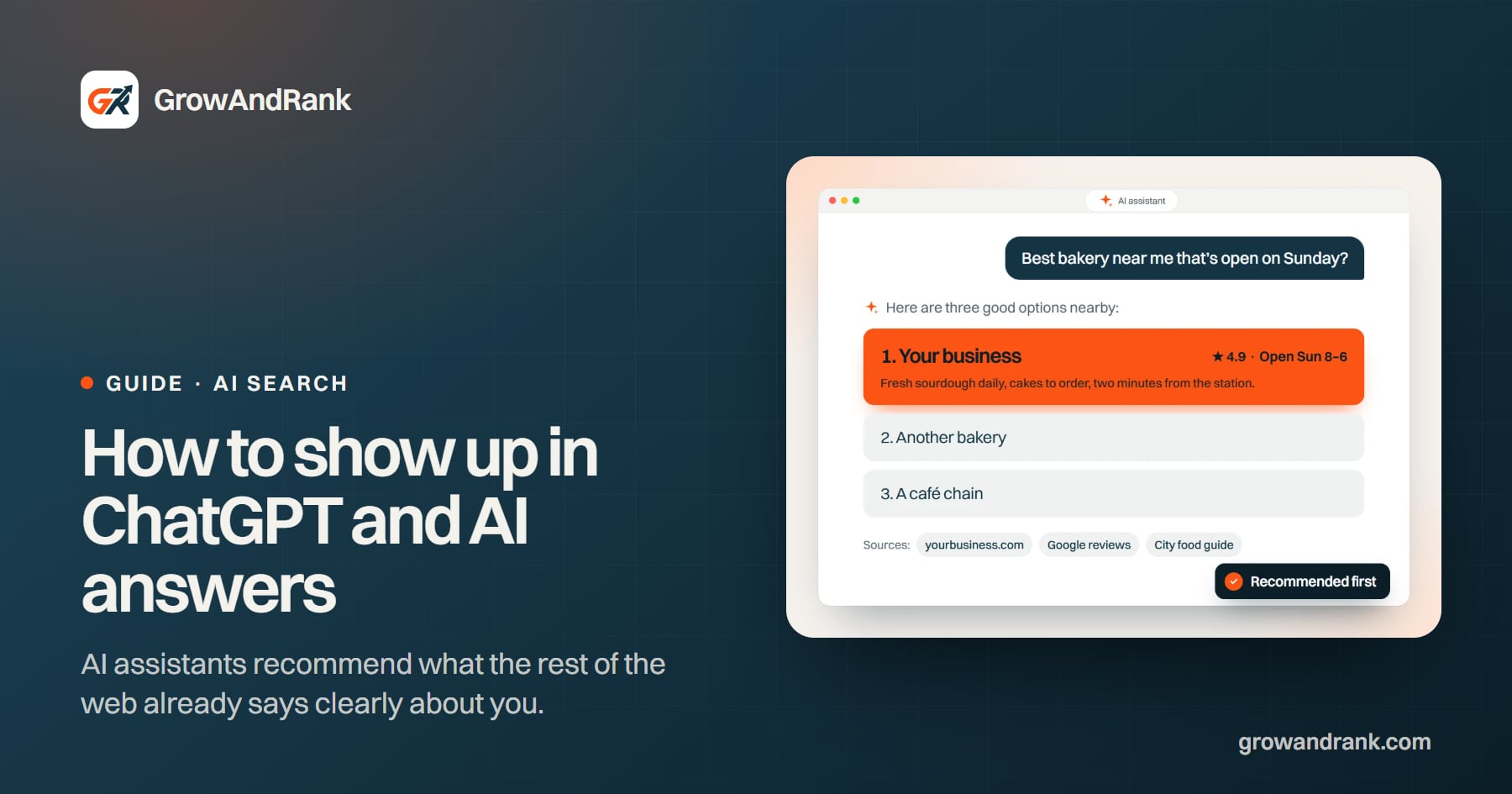
- AI assistants recommend what the rest of the web already says clearly about you.
- Let the AI crawlers in, and make sure your pages work without JavaScript.
- Keep your name, address, services and links identical everywhere.
- Answer real questions on your pages, then check monthly what the assistants say.
How do AI assistants decide which businesses to recommend?
ChatGPT, Gemini, Perplexity, Copilot and Google’s AI Overviews don’t keep a secret list of favourite companies. When someone asks for a recommendation, they search the web, read a handful of pages, and summarise what those pages agree on.
That means three things decide whether you are named: whether the assistant can read your website at all, whether your business facts are clear and consistent, and whether other trusted sites mention you too. Good SEO already covers most of this. AI search simply rewards it more and punishes vague or contradictory information harder.
Let AI crawlers read your website
Each assistant has its own crawler, and your robots.txt file decides whether it may visit. Many sites block them by accident, through a security plugin or a copied template. Check that these are allowed:
- OAI-SearchBot and ChatGPT-User, which ChatGPT uses for search and for pages people ask it to open. GPTBot is OpenAI’s training crawler; you can block it and still appear in ChatGPT search.
- Googlebot, which feeds both Google Search and the AI Overviews. Blocking Google-Extended stops Gemini training on your content but does not remove you from Search.
- Bingbot, because Copilot and several other assistants lean on Bing’s index, not only Google’s.
- PerplexityBot, and ClaudeBot and Claude-SearchBot for Anthropic’s Claude.
Make sure your pages work without JavaScript
Most AI crawlers read the raw HTML your server sends and don’t run JavaScript. If your services, prices or contact details only appear after a script loads, the assistant may see an empty page.
Open your site with JavaScript switched off, or view the page source, and check that the important text is there. Server-rendered or prerendered pages, the default in frameworks like Next.js and Astro, solve this, and they are faster for people too.
Make your business facts impossible to misread
Assistants get nervous about contradictions. If your website says one phone number, Google another and a directory a third, they are less likely to name you with confidence. Pick one version of each fact and use it everywhere:
- Business name, written exactly the same way on every site.
- Address and service area, phone number and opening hours.
- A one-sentence description of what you do and who you do it for.
- Links between your website and your Google Business Profile, LinkedIn, Facebook and Instagram pages.
- Structured data on your site: Organization or LocalBusiness, plus Person for the founder, with sameAs links to those profiles.
Write pages that answer questions directly
When an assistant reads your page, it is looking for a sentence it can trust and quote. Pages that open with a clear answer get used; pages that open with a slogan get skipped.
Give every service its own page. Use the questions customers really ask as headings (“How long does a Shopify store take to build?”), answer in the first sentence underneath, then add the detail. Name the places you serve, the industries you know and the results you can show, with real examples rather than adjectives.
Get mentioned on other trusted sites
Your own website is one source. Assistants trust you more when independent sites say the same thing. The mentions that matter most are usually the ones you can earn steadily:
- Google reviews that describe the work in the customer’s own words.
- Listings in the directories for your industry and city, with the same details as your site.
- Partner pages, client case studies and local news or association websites.
- Helpful, honest answers in the communities where your customers ask questions.
Google Business Profile and Bing Places still matter
For local questions, AI answers lean heavily on map listings. Keep your Google Business Profile complete, with categories, services, photos and recent posts, and claim your Bing Places listing too, which takes a few minutes and is often forgotten. Our local SEO checklist covers both step by step.
Does llms.txt help?
llms.txt is a proposed standard: a plain-text file at the root of your site that summarises who you are and links to your key pages, written for language models. It is cheap to add and does no harm, and some tools read it. None of the major assistants has said it affects their recommendations, so treat it as a tidy extra, not the main work.
How to check whether ChatGPT recommends your business
Once a month, ask the main assistants the questions your customers would ask, with your city or niche in them, and note who gets named and which sources are cited. Those sources are where you want to be mentioned next.
In Google Analytics, look at referral traffic from chatgpt.com, perplexity.ai, gemini.google.com and copilot.microsoft.com. ChatGPT also adds utm_source=chatgpt.com to the links it shares, so those visits are easy to spot. The numbers start small; the trend is what matters.
Frequently asked questions
Can I pay to be recommended by ChatGPT?
No. The businesses an assistant names in its answer come from what it finds and reads on the web. Where an assistant shows ads, they are labelled separately from the answer itself.
Is SEO still worth it now that people use AI search?
Yes. AI assistants search the web before they answer, so a fast, clear, well-linked website with consistent business details is what gets read and quoted. Good SEO and good AI visibility are mostly the same work.
What are GEO and AEO?
Generative engine optimisation (GEO) and answer engine optimisation (AEO) are names for making your content easy for AI assistants and answer boxes to find, understand and quote. In practice they build on SEO: crawlable pages, clear answers, structured data and trusted mentions.
Should I block GPTBot in robots.txt?
It is your choice. GPTBot collects content for training OpenAI’s models; blocking it does not stop you appearing in ChatGPT search, which uses OAI-SearchBot. If you want to be found, keep OAI-SearchBot and ChatGPT-User allowed.
How long does it take to start showing up in AI answers?
Usually weeks to a few months. Assistants have to recrawl your site and the sites that mention you, so fixes to crawling and business details show up first, while reviews and mentions build over time.