

Key takeaways
- AI can build a good first version of a simple website in minutes.
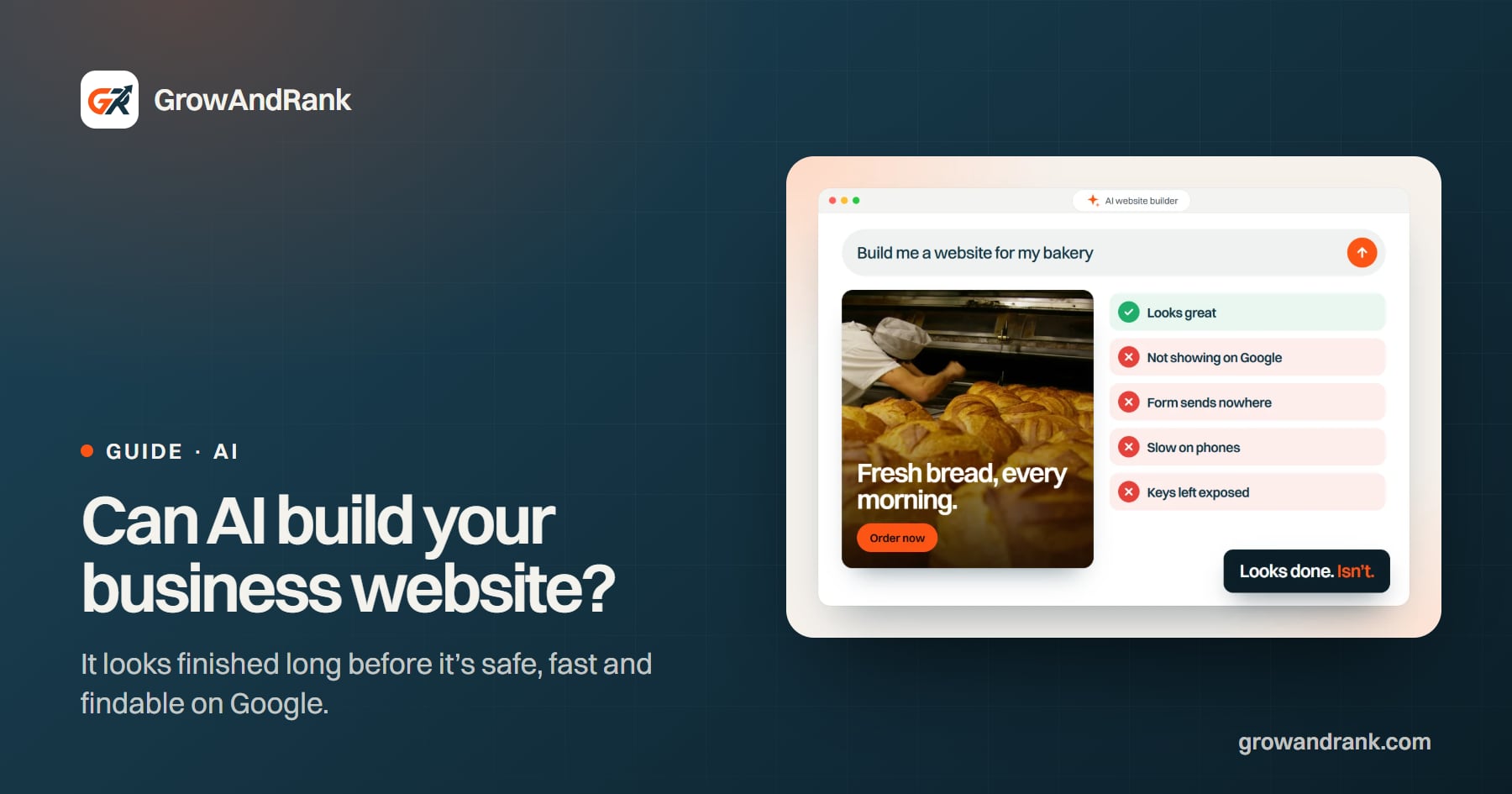
- It looks finished long before it’s safe, fast and findable on Google.
- The risk grows with what the site handles: payments, logins, customer data.
- The best route for many businesses: start with AI, finish with a developer.
Can AI build a website? The short answer
Yes. Today’s AI tools can turn a plain-English description into a working website, and for a simple brochure site or a landing page to test an idea, that is genuinely useful.
But a website that exists is not the same as a website that works for your business. The first 80% now takes minutes. The last 20% is what decides whether customers can find it, trust it and buy from it, and that part still needs someone who knows what to check.
What is vibe coding, in plain English?
Vibe coding is building software by describing what you want to an AI and accepting what it writes, without reading the code yourself. The term came from AI researcher Andrej Karpathy in early 2025 and has since become the name for a whole wave of tools, such as Lovable, Bolt, Replit and v0.
They sit alongside AI features in website builders like Wix and Framer. The difference matters: a website builder gives you a managed platform that handles hosting and security for you, while a vibe coding tool hands you custom code that is now yours to look after.
What AI website builders do well
Used for the right job, these tools are excellent. They shine when you need:
- A landing page to test whether anyone wants your idea, before you spend real money.
- A simple one to three page site with your details, services and a contact link.
- A clickable prototype to show investors, partners or your own team.
- First drafts of layouts and wording you can react to, instead of a blank page.
Where AI-built websites break
The problems rarely show on the first screen. They appear after launch, when real people and real data arrive:
- Forms that look fine but send messages nowhere, or fill up with spam.
- Layouts that break on some phones, because only one screen size was ever tried.
- Slow pages, because nobody resized the images or removed the code that isn’t used.
- Changes that get harder over time: ask the AI to fix one thing and it breaks another.
- No backups and no plan for when a tool changes its pricing or shuts down.
- Generic wording that sounds like every other business, because it was written from nothing.
Is an AI-built website good for SEO?
Often not, at least out of the box. Many AI-generated sites build the whole page with JavaScript in the visitor’s browser, so crawlers that don’t run JavaScript, including most AI search crawlers, can receive a nearly empty page.
We also regularly see the same title on every page, missing descriptions, no structured data, no sitemap, and headings chosen for looks rather than meaning. None of this is visible to you, and all of it makes you harder to find. If you already have one, view the page source and check that your services and location appear in the text. Our guide to showing up in ChatGPT and Google’s AI answers covers what to fix next.
Is vibe coding safe for a business website?
It depends entirely on what the site does. A page with your opening hours carries little risk. A site that takes logins, bookings or payments is different, because AI-written code often works perfectly while being wide open. Before anything like that goes live, someone should confirm:
- No secret keys or passwords are visible in the code sent to the browser.
- One customer can’t see another customer’s data by changing a link.
- Payments go through a provider like Stripe or Shopify, never your own card form.
- Forms are protected from spam and from malicious input.
- Backups run automatically, and someone has tested restoring one.
- You know where customer data is stored, and you’re allowed to store it there.
AI website builder vs web developer: which do you need?
Ask what happens if the site fails. A rough guide:
- Testing an idea or just need a simple online presence: use an AI builder, and keep it simple.
- Local business that depends on Google and on calls: a developer pays for itself, because being found is the whole point.
- Selling products: use Shopify, with an expert on the theme, speed and setup. Don’t generate your own checkout.
- Logins, customer data or a SaaS product: a developer from the start, or a full review before launch.
- Your website brings in most of your revenue: treat it like the business asset it is.
The middle path: start with AI, finish with a developer
You don’t have to choose one or the other. Plenty of good projects now start with a founder’s AI prototype. It shows exactly what they want, faster and more clearly than any brief.
A developer then keeps what works and rebuilds what doesn’t: real hosting, proper forms, security, speed, SEO and a structure that can grow. You keep the speed of AI without betting your business on code nobody has read.
How professional developers really use AI
We use AI on our own projects every day. It writes first drafts, speeds up repetitive work and catches mistakes. What it doesn’t replace is judgement: knowing what to build, reading what it wrote, testing on real phones, and owning the result when something goes wrong.
That is the real difference between vibe coding and professional work. It isn’t whether AI was used. It’s whether anyone checked.
Frequently asked questions
Can AI build a complete website for free?
Many tools let you generate a site for free, but publishing it on your own domain, keeping it online and adding real features usually needs a paid plan. Check what you’d pay each month, and whether you can take your site with you if you leave.
Will AI replace web developers?
It is replacing some of the routine work, and simple sites no longer need a developer to get started. Businesses still need someone who can decide what to build, make it secure and fast, and fix it when it breaks, so the job is changing rather than disappearing.
Is vibe coding safe?
For a simple page with no customer data, the risk is low. For anything with logins, payments or personal data, AI-written code should be reviewed by someone who can read it, because it can work perfectly and still leave data exposed.
Can AI build a Shopify store?
AI can help with product descriptions, images and theme changes, and Shopify has AI features of its own. The store still needs someone to set up payments, shipping, taxes and speed properly, because mistakes there cost you orders.
Who owns a website built with AI?
It depends on the tool’s terms. On a hosted builder your site usually lives on their platform and can be hard to move. With vibe coding tools you can often export the code, but you then need hosting and someone who can maintain it.
My AI-built site isn’t getting traffic. What should I check first?
View the page source and confirm your real text is in it, not just scripts. Then check each page has its own title and description, that you have a sitemap in Google Search Console, that the site is fast on a phone, and that your Google Business Profile is complete.